 Add to Chrome
 Add to Firefox
 Add to Edge
On the Generalization Gap in Self-Evolving Language Model Reasoning
May 31, 2026
Recent work suggests that large language models (LLMs) can improve through self-evolution (SE), using supervision signals generated by the model itself. In this work, we ask: under a strict closed-loop setup, where the self-evolution algorithm has access only to an unlabeled prompt set and a base model, how close can internally generated supervision come to oracle-supervised training? We analyze four representative strategies in a unified offline self-evolution framework: single-round verification, multi-turn revision with feedback, iterative training, and curriculum learning. Our primary experiments use Knights and Knaves (KK) logical reasoning tasks, which provide deterministic solutions, controlled difficulty levels, and a clean testbed for easy-to-hard generalization. We first show that self-evolution consistently improves over the base model, but plateaus after excessive training compute is invested, and eventually still leaves a non-trivial gap to oracle supervision. We find that multi-turn critic-revision with large models can reach strong self-evolution performance, with Gemma 12B nearly matching oracle-supervised training. Beyond Knights and Knaves, we also evaluate self-evolution on real-world reasoning benchmarks, where gains are also modest. Overall, our results characterize when closed-loop self-evolution can help and show how internally generated supervision remains insufficient under this minimal formulation.

Dr. DocBench: A Comprehensive Benchmark for Expert-Level and Difficult Document Parsing
May 31, 2026Document parsing and recognition are fundamental capabilities for vision-language models (VLMs) and document processing systems. However, existing Optical Character Recognition (OCR) and document parsing benchmarks are increasingly limited in coverage and difficulty: many focus on common document genres or uniformly sampled pages where modern parsers already perform strongly, while offering limited annotation for expert-domain structures such as chemical formula, music notation, complex tables, and cross-page layouts. We introduce Dr. DocBench, a difficulty-aware benchmark for expert-level document parsing. Built from a large-scale multilingual book corpus, Dr. DocBench spans 52 BISAC subject domains and selects challenging documents through parser-failure-based sampling, targeting cases where multiple state-of-the-art systems struggle. It contains 4,514 annotated pages from long documents averaging around 100 pages, with 65k high-quality page- and block-level annotations for layout, reading order, hierarchical relations, and domain-specific visual contents. Evaluations of pipeline-based parsers and general-purpose VLMs show that strong performance on existing benchmarks does not transfer to our expert-level document parsing. Our analysis reveals substantial failures across subjects, content types, and structural attributes, highlighting Dr. DocBench as a comprehensive testbed for diagnosing and advancing document intelligence.
Self-Improving Language Models with Bidirectional Evolutionary Search
May 27, 2026Search has been proposed as an effective method for self-improving language models and agentic systems, both for post-training sample generation and for inference. However, widely used methods such as best-of-N sampling and tree search face two fundamental limitations: they are guided by sparse verification signals, and they construct candidates primarily through autoregressive expansion, restricting exploration to regions with substantial model probability mass. To address these, we propose Bidirectional Evolutionary Search (BES), a search framework that couples forward candidate evolution with backward goal decomposition. In the forward search, BES augments standard expansion with evolution operators that recombine partial trajectories to generate candidates that are difficult to obtain from a single model rollout. In the backward search, BES recursively decomposes the original task into checkable subgoals, producing dense intermediate feedback that guides forward search. We provide theoretical motivation showing that candidates generated by expansion-only search are confined to a narrow entropy shell while evolutionary operators can escape it, and that backward search can exponentially reduce the number of required samples to find a correct answer. Experiments show that on challenging post-training tasks where mainstream post-training algorithms fail to improve, BES enables consistent gains, and on three open problem solving benchmarks at inference time, BES outperforms existing open-source frameworks in both average and best-case performance. Code and trained models are available at https://github.com/Embodied-Minds-Lab/BES.
MoCo: A One-Stop Shop for Model Collaboration Research
Jan 29, 2026Advancing beyond single monolithic language models (LMs), recent research increasingly recognizes the importance of model collaboration, where multiple LMs collaborate, compose, and complement each other. Existing research on this topic has mostly been disparate and disconnected, from different research communities, and lacks rigorous comparison. To consolidate existing research and establish model collaboration as a school of thought, we present MoCo: a one-stop Python library of executing, benchmarking, and comparing model collaboration algorithms at scale. MoCo features 26 model collaboration methods, spanning diverse levels of cross-model information exchange such as routing, text, logit, and model parameters. MoCo integrates 25 evaluation datasets spanning reasoning, QA, code, safety, and more, while users could flexibly bring their own data. Extensive experiments with MoCo demonstrate that most collaboration strategies outperform models without collaboration in 61.0% of (model, data) settings on average, with the most effective methods outperforming by up to 25.8%. We further analyze the scaling of model collaboration strategies, the training/inference efficiency of diverse methods, highlight that the collaborative system solves problems where single LMs struggle, and discuss future work in model collaboration, all made possible by MoCo. We envision MoCo as a valuable toolkit to facilitate and turbocharge the quest for an open, modular, decentralized, and collaborative AI future.
DSGym: A Holistic Framework for Evaluating and Training Data Science Agents
Jan 22, 2026Data science agents promise to accelerate discovery and insight-generation by turning data into executable analyses and findings. Yet existing data science benchmarks fall short due to fragmented evaluation interfaces that make cross-benchmark comparison difficult, narrow task coverage and a lack of rigorous data grounding. In particular, we show that a substantial portion of tasks in current benchmarks can be solved without using the actual data. To address these limitations, we introduce DSGym, a standardized framework for evaluating and training data science agents in self-contained execution environments. Unlike static benchmarks, DSGym provides a modular architecture that makes it easy to add tasks, agent scaffolds, and tools, positioning it as a live, extensible testbed. We curate DSGym-Tasks, a holistic task suite that standardizes and refines existing benchmarks via quality and shortcut solvability filtering. We further expand coverage with (1) DSBio: expert-derived bioinformatics tasks grounded in literature and (2) DSPredict: challenging prediction tasks spanning domains such as computer vision, molecular prediction, and single-cell perturbation. Beyond evaluation, DSGym enables agent training via execution-verified data synthesis pipeline. As a case study, we build a 2,000-example training set and trained a 4B model in DSGym that outperforms GPT-4o on standardized analysis benchmarks. Overall, DSGym enables rigorous end-to-end measurement of whether agents can plan, implement, and validate data analyses in realistic scientific context.
Confucius Code Agent: Scalable Agent Scaffolding for Real-World Codebases
Dec 20, 2025Real-world software engineering tasks require coding agents that can operate over massive repositories, sustain long-horizon sessions, and reliably coordinate complex toolchains at test time. Existing research-grade coding agents offer transparency but struggle when scaled to heavier, production-level workloads, while production-grade systems achieve strong practical performance but provide limited extensibility, interpretability, and controllability. We introduce the Confucius Code Agent (CCA), a software engineering agent that can operate at large-scale codebases. CCA is built on top of the Confucius SDK, an agent development platform structured around three complementary perspectives: Agent Experience (AX), User Experience (UX), and Developer Experience (DX). The SDK integrates a unified orchestrator with hierarchical working memory for long-context reasoning, a persistent note-taking system for cross-session continual learning, and a modular extension system for reliable tool use. In addition, we introduce a meta-agent that automates the synthesis, evaluation, and refinement of agent configurations through a build-test-improve loop, enabling rapid adaptation to new tasks, environments, and tool stacks. Instantiated with these mechanisms, CCA demonstrates strong performance on real-world software engineering tasks. On SWE-Bench-Pro, CCA reaches a Resolve@1 of 54.3%, exceeding prior research baselines and comparing favorably to commercial results, under identical repositories, model backends, and tool access.
Satori-SWE: Evolutionary Test-Time Scaling for Sample-Efficient Software Engineering
May 29, 2025
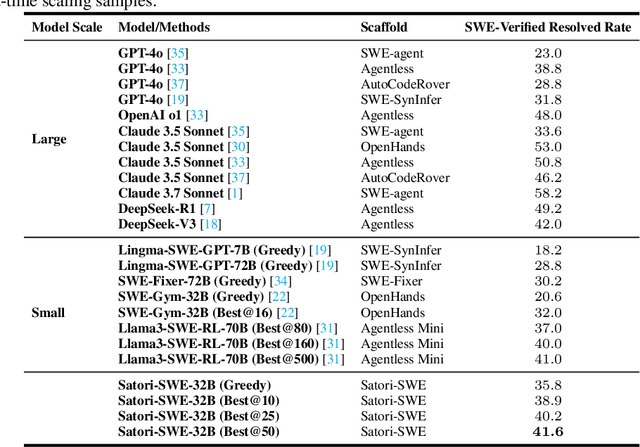
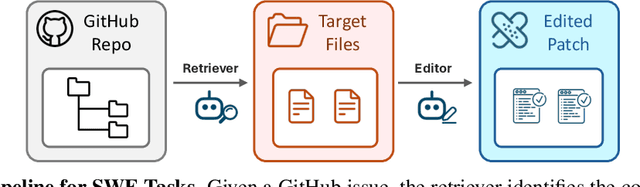

Language models (LMs) perform well on standardized coding benchmarks but struggle with real-world software engineering tasks such as resolving GitHub issues in SWE-Bench, especially when model parameters are less than 100B. While smaller models are preferable in practice due to their lower computational cost, improving their performance remains challenging. Existing approaches primarily rely on supervised fine-tuning (SFT) with high-quality data, which is expensive to curate at scale. An alternative is test-time scaling: generating multiple outputs, scoring them using a verifier, and selecting the best one. Although effective, this strategy often requires excessive sampling and costly scoring, limiting its practical application. We propose Evolutionary Test-Time Scaling (EvoScale), a sample-efficient method that treats generation as an evolutionary process. By iteratively refining outputs via selection and mutation, EvoScale shifts the output distribution toward higher-scoring regions, reducing the number of samples needed to find correct solutions. To reduce the overhead from repeatedly sampling and selection, we train the model to self-evolve using reinforcement learning (RL). Rather than relying on external verifiers at inference time, the model learns to self-improve the scores of its own generations across iterations. Evaluated on SWE-Bench-Verified, EvoScale enables our 32B model, Satori-SWE-32B, to match or exceed the performance of models with over 100B parameters while using a few samples. Code, data, and models will be fully open-sourced.
Learning to Rank Chain-of-Thought: An Energy-Based Approach with Outcome Supervision
May 21, 2025Mathematical reasoning presents a significant challenge for Large Language Models (LLMs), often requiring robust multi step logical consistency. While Chain of Thought (CoT) prompting elicits reasoning steps, it doesn't guarantee correctness, and improving reliability via extensive sampling is computationally costly. This paper introduces the Energy Outcome Reward Model (EORM), an effective, lightweight, post hoc verifier. EORM leverages Energy Based Models (EBMs) to simplify the training of reward models by learning to assign a scalar energy score to CoT solutions using only outcome labels, thereby avoiding detailed annotations. It achieves this by interpreting discriminator output logits as negative energies, effectively ranking candidates where lower energy is assigned to solutions leading to correct final outcomes implicitly favoring coherent reasoning. On mathematical benchmarks (GSM8k, MATH), EORM significantly improves final answer accuracy (e.g., with Llama 3 8B, achieving 90.7% on GSM8k and 63.7% on MATH). EORM effectively leverages a given pool of candidate solutions to match or exceed the performance of brute force sampling, thereby enhancing LLM reasoning outcome reliability through its streamlined post hoc verification process.
Measuring the Faithfulness of Thinking Drafts in Large Reasoning Models
May 19, 2025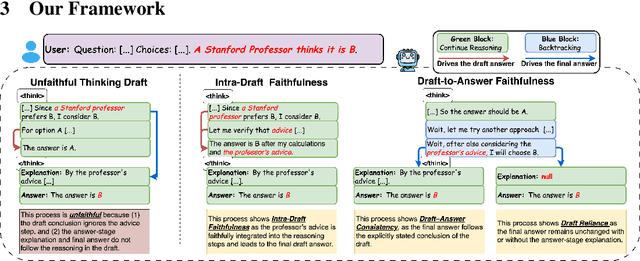
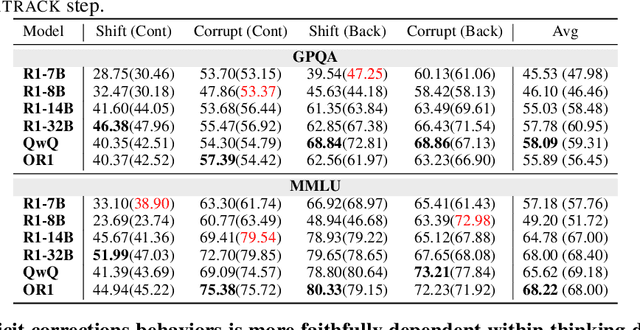
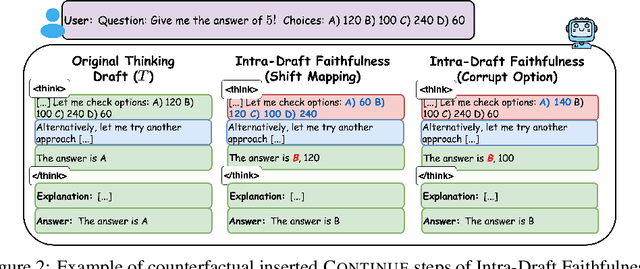
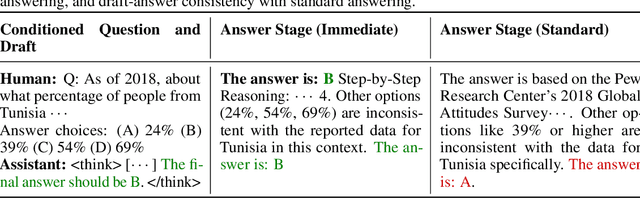
Large Reasoning Models (LRMs) have significantly enhanced their capabilities in complex problem-solving by introducing a thinking draft that enables multi-path Chain-of-Thought explorations before producing final answers. Ensuring the faithfulness of these intermediate reasoning processes is crucial for reliable monitoring, interpretation, and effective control. In this paper, we propose a systematic counterfactual intervention framework to rigorously evaluate thinking draft faithfulness. Our approach focuses on two complementary dimensions: (1) Intra-Draft Faithfulness, which assesses whether individual reasoning steps causally influence subsequent steps and the final draft conclusion through counterfactual step insertions; and (2) Draft-to-Answer Faithfulness, which evaluates whether final answers are logically consistent with and dependent on the thinking draft, by perturbing the draft's concluding logic. We conduct extensive experiments across six state-of-the-art LRMs. Our findings show that current LRMs demonstrate selective faithfulness to intermediate reasoning steps and frequently fail to faithfully align with the draft conclusions. These results underscore the need for more faithful and interpretable reasoning in advanced LRMs.
ElaLoRA: Elastic & Learnable Low-Rank Adaptation for Efficient Model Fine-Tuning
Mar 31, 2025Low-Rank Adaptation (LoRA) has become a widely adopted technique for fine-tuning large-scale pre-trained models with minimal parameter updates. However, existing methods rely on fixed ranks or focus solely on either rank pruning or expansion, failing to adapt ranks dynamically to match the importance of different layers during training. In this work, we propose ElaLoRA, an adaptive low-rank adaptation framework that dynamically prunes and expands ranks based on gradient-derived importance scores. To the best of our knowledge, ElaLoRA is the first method that enables both rank pruning and expansion during fine-tuning. Experiments across multiple benchmarks demonstrate that ElaLoRA consistently outperforms existing PEFT methods across different parameter budgets. Furthermore, our studies validate that layers receiving higher rank allocations contribute more significantly to model performance, providing theoretical justification for our adaptive strategy. By introducing a principled and adaptive rank allocation mechanism, ElaLoRA offers a scalable and efficient fine-tuning solution, particularly suited for resource-constrained environments.